
Yes you can! Just call the Helpline 01373 471117. Bob will be pleased to talk to you if he is available; if not just ask for him to call you. You will be under no obligation.
To learn more about us why not watch the video below :
This is a very common situation and requires advice from an experienced professional who understands both the problem and the solution.
The Problem: Very often, with what are known as “blended families”, each partner wishes to do the right thing for both the other partner and their own children. Circumstances vary of course but it could, for example, be that one partner owns the property in which they all live and want that property to go to their own children. Whatever the specific circumstances and the desired outcome might be a Will can usually be written that protects all concerned as far as possible.
If these are your circumstances you might benefit from a conversation with an experienced professional who understands both the problem and the available solutions. There is absolutely no obligation.
The Problem: If the survivor of you remarries that will automatically revoke any Will previously written. A new Will needs to be arranged to take into account the new circumstances. There is always a danger that the remarriage results in the death of the survivor of you without a Will that protects the interests of your children or that the new Will does not adequately ensure that your children receive what you feel they should. It is understandable that greater concerns arise nowadays than in the past about protecting the inheritance of children against circumstances that might threaten it. After all, with the value of property these days there is often more to lose.
The solution: Most couples own their property jointly. This means the survivor then owns the whole property regardless of what is in your Will. It is easy to own your property as individual shares instead. Then your Will could easily include a provision that allows the survivor to live in the family home; usually for their lifetime, even to sell it and buy an alternative home, but thereafter the share of the property owned by the first to die goes to the children regardless of what has happened in the meantime. Various safeguards for the survivor can be included so they are protected. We are experienced in these matters and can advise you of your options. The solution is simple, it is inexpensive and it works.
It can also help in regard to potential care fees.
You have asked an increasingly important question.
More and more people are finding out just how important this is. Unfortunately, many are finding that out when it is needed and that is often just too late. It is a common misconception that if a bank account is jointly held the other person will be able to continue to use it without any problem but that is not always the case. Institutions such as local authorities and government departments and just about anybody you need to deal with on someone’s behalf are not as helpful as you might assume they will be. The problems that arise can be extremely stressful. Also a Lasting Power of Attorney means that it is the people you want to look after your affairs and your welfare – those who love you and know you – will be the ones who can do so.
Martin Lewis video:
Ah… yes… Care fees. Very good question. So lets get into it. I am asked mostly about making sure the property isn’t lost to pay for care so I’ll focus on that.
Part One: There are things you can do but first let’s be clear about what you absolutely should not do. In Part Two I’ll explain a popular straightforward arrangement.
* If you give your property to your children now you will be left with no security. If a child goes through a divorce or is made bankrupt then the property may have to be sold and you would be homeless.
* Assuming you continue to live in it then it is a “gift with reservation of benefit” and the full value of the property at your death (not at the time you gave it to your children) will be added to your estate and included as part of your inheritance tax assessment.
* While the reservation of benefit rules dictate that HMRC treat it as though you still own it for inheritance tax purposes the legal owners are your children and, as it is not their principal private residence, when the property is sold they will be liable for capital gains tax on the difference between the value when they became owners and the value upon sale. If the property passes at your death capital gains tax does not apply.
* Paying a full commercial rent to your children as landlords for the rest of your life will overcome the reservation of benefit rules but that is not a popular solution. The capital gains tax issue would still remain for them and they would obviously pay tax on the rent you pay. So you’d be paying rent on property that your children own and you might still pay inheritance tax on the property. And you would still have no security.
* Burt it could get worse. If it is held that you gave away your property, or indeed money or any assets deliberately to avoid paying for care which you later needed and for which you were unable to pay that is called “deliberate deprivation of assets”. The person or persons receiving the money or other assets that had left you unable to pay can be held liable. That may leave them in a very awkward position indeed.
Part Two: OK, so what can I do?
Most people own their property jointly which means that, regardless of what your Will says, it will pass to the survivor of you upon first death. If the survivor of you then goes into care the property may need to be sold to pay for it with the potential loss of the whole property.
You can easily and inexpensively arrange for each of you to own a separate share of your property. You can write a Will that leaves your share to your beneficiaries but gives the survivor of you a life interest in it. And then….
A. If you go into care and your spouse or partner is still living in the property then, as Age UK say: “Under UK social care rules (such as the Care Act 2014 in England), the property is strictly disregarded from the financial assessment (means test) for care home fees as long as a qualifying partner or dependent lives there.” At that time the whole of the property is saved.
B. If, following first death, the survivor goes into care then their share of the property is available to pay for it but at least half of the value has then been saved which might not otherwise be the case and the outlay has been very low compared to the amount saved. The share of the property that was owned by the first to die is held in trust for their beneficiaries. Only the person who needs care can be made to pay for it and clearly the person who has died does not need care.
Well, its not a tax rise as such but from April 2027 the calculation will include unused private pension pots so yes more will be paid. The addition of such funds to the sum on which Inheritance Tax is calculated will bring more people into the Inheritance Tax bracket and bring a big smile to the face of the Chancellor of the Exchequer. You will still have the same allowances against your overall IHT position but if you have a private pension the new rules may affect you.
In fact, even without this rule change many people are at risk without fully realising why. It is important to check if that might include you; please allow me to explain.
Are You Making This Tax Planning Mistake?
Not everyone is aware that inheritance tax can end up being paid on their assets even when their estate is under the threshold. For a married couple the combined thresholds (all things being equal) add up to £1million and those whose assets are less than that are often, understandably, convinced they don’t need to even look at it. But when everything is passed on to the next generation it may either cause IHT to be payable on their estates or, if the beneficiaries are already liable to IHT, increase the amount payable. And don’t forget that while the additional tax is paid from the children’s estates it is really the parent’s money on which the additional tax is payable and also where a solution can effectively and inexpensively be applied.
Also, even if inheritance tax is payable on your estate it may not be the total extent of the tax HMRC take. That is because, as explained above, once it is part of a beneficiary’s estate tax will be calculated again. So even where tax has already been paid it may become taxable again. And at 40% again.
There is a solution often used by well informed families who take wealth and asset protection seriously. Not everyone knows about it but it is tried, it is tested, it is not expensive. And it works.
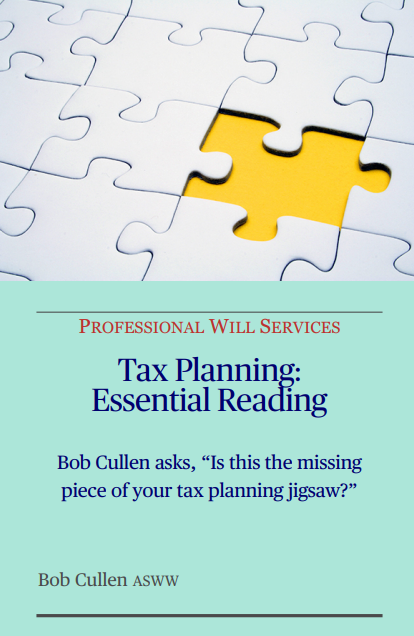
We recommend that you use the link to the booklet below where we believe you may learn something to your advantage.
And if you would like to discuss this further or have any question just call the Helpline for a no-obligation chat. I look forward to speaking with you.
HELPLINE: 01373 471117
The link to the pamphlet can be found on the Tax Planning: Essential Reading page at the Botton of the blue text box (discover more button)